Sandstone Futurism: Part 1.5
Sandstone Futurism post-script, written in exile in London. Non-locality, bricking it, archeomancy, vortices.

This was initially meant to just be a reflection on my text Sandstone Futurism, with a side note about how my interest in [re]localisation has mainly been concerned with the fringes, not capital cities. Then it started to be longer than a single create mode story and less funny and also I’m living in a capital city for a bit (London) instead of the Sandstone Mecca which has added a dimension so I moved over to the notes app. This happened with the original article too where I sat in bed and then accidentally wrote it all. I can’t call it Sandstone Futurism: Part 2 because I want to do a cross-analysis with Dune Part 2 as a hermeneutics of sand/sandstone thing so I have to save the title.
‘ … the Earth about London, rightly managed, will yield as good Brick as were the Roman Bricks, (which I have often found in the old Ruins of the City) & will endure, in our Air, beyond any Stone our Island affords’. - Christopher Wren, as quoted in Parentalia; or Memoirs, 1750.
‘The ground below [our minds] is hole-y.’ - China Miéville, ‘The Dusty Hat,’ 2011.
‘You will pass too, ending crotcheted by red leaves of herb Robert, stars of cow thistle. I see your car crashes. I see economies collapse. I sense the unspoken family secrets; I see the white cow-gate lit by sunshine. I am the centre.’ - Nick Papadimitriou, in Scarp, 2013.
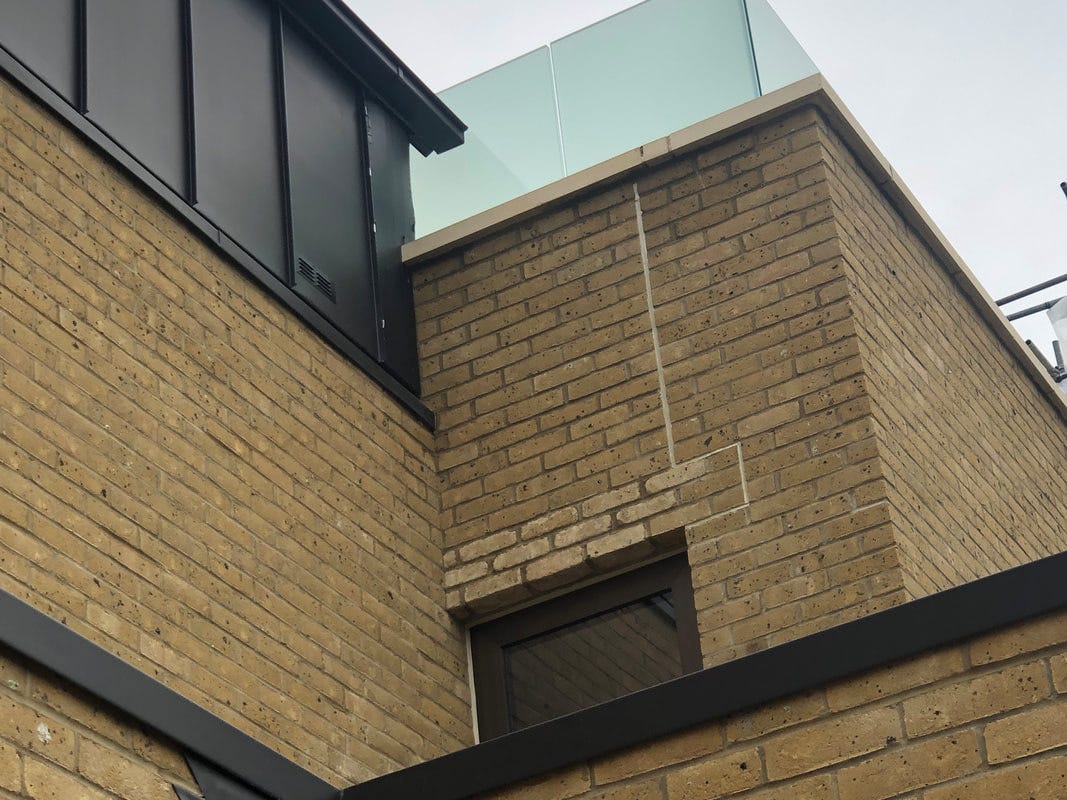
I don’t think London could ever have its own Sandstone Futurism. Its sense of place is ungeological. Romans preferred their ragstone from Kent, Georgians preferred stucco, Victorian’s went with French Caen stone which is shit so they changed to Portland. The only answer to Yellowblock (Sydney Sandstone durrrr) is Yellow stock - a silty glacial dust spun with ‘Spanish’ (i.e. an admixture of ash and cinders burnt from literal garbage and street sweepings) into peppered bars of sooty gold. No quarry required, Yellow stock is churned from the subsoil at the site of its use - fired into rough edged chunks that only harden in polluted atmospheres. Brickearth is a basin of flecked citystuff tilled in open caskets. Her clamps are penned in by reddish cousins on iron boards and licked with mortar.
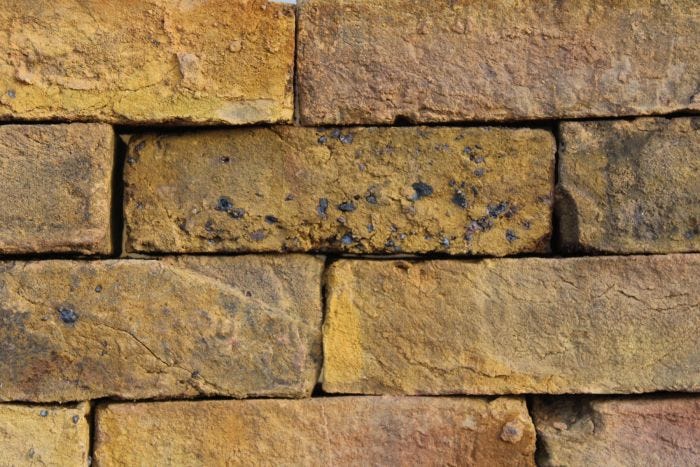
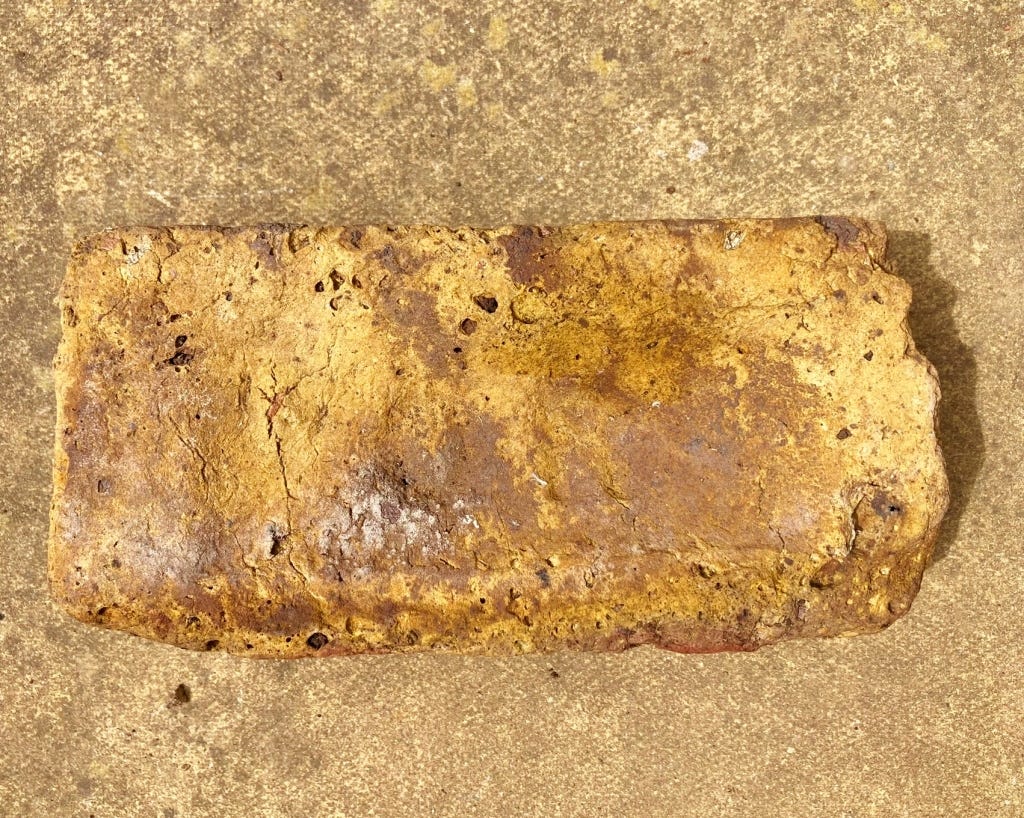
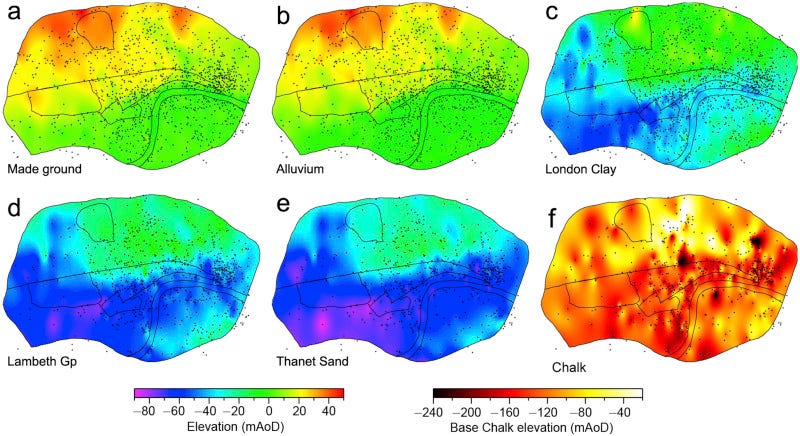
Beneath this crust of chalked sediment there is London Clay, which can’t be baked by itself. Unlike Sydney, there is no durable stone here to articulate any local vernacular. Clay lends itself to an inverse architecture of subtraction. Unfired clay swallows→shrinks→swells - it cannot be heaped into positive structures. It’s not its presence as a medium that matters, but the possibility of its absence for boring out subterranean spaces. The few skyscrapers in the city must bob on rafts ‘plunged-piled’ beneath the surface. North of the river, where the silt deposits thin out, we find even less bricks and more tunnels. There’s also at least 200 km of active tunnels in the transport network, and this doesn’t include Military Citadels, waste systems, or utilities. In 2017, Newcastle University reported that 4,650 new basements had been green-lit over ten years within a poxy data-slice of wealthy West London boroughs. 112 of these were ‘megabasements’, with three stories or more.1 Rather then expressing a relationship to its environment, this architecture interiorises itself below the subsurface.
Initially, I wanted to write about how a certain flavour of new build here in London recalled a Sandstone Futuresque sympathy for heritage materials, subbing out pebbledash for reclaimed brick. These two-up-two-downs lined backstreets with their sparse, yellow facades, and poked out the back of houses. Yet their sentiment felt unfamiliar to the excitement of Sydney’s recent public projects. The examples I could find are largely residential, tucked away in pockets of the South East. Even on architecture sites like Dezeen, celebrated experiments in Yellow Stock Brick from recent years consist of tiny-house initiatives and low-profile extensions. Eventually I realised the fact that Yellow Stock Futurism doesn’t really exist is far more exciting than the fact that it ever could. Sandstone Futurism was never written for cities like London. Sandstone Futurism necessitates a grounding through (re)localisation. It was written for the peripheries, which negotiate their distance to the center through developing a unique regionality. London however represents itself as ‘the center’ 0° 0' 0" a nexus point within a vast system of relationships between spaces and temporalities. The foundation of London maintains a superfluid state, destabilizing the reality of those who exist within it. What can be local within a singularity that engulfs its own event horizon? Hunks of regurgitated ash/bone/dust, hardened into yellowish scabs. A pseudo-stratigraphy of decay; matter neither archeological nor geological. London is bricked up!
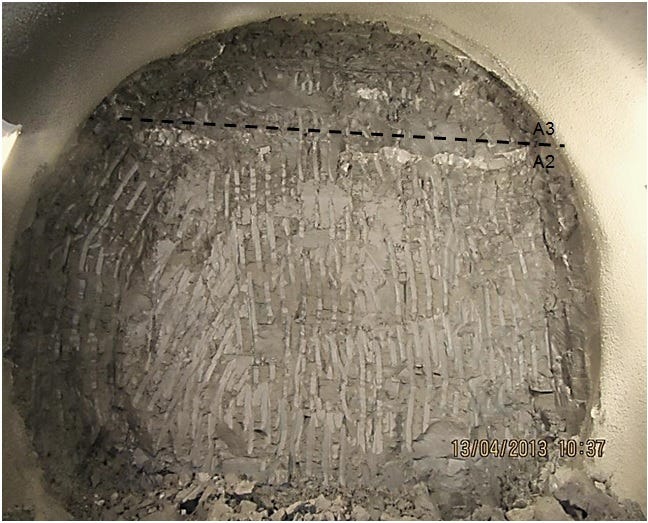
I read that stacked together, they would be 50 times taller then The Shard. Which is stupid because 4,650 regular buildings stacked could also be 50 times taller then The Shard.
There certainly exists a stubborn teleology at play in both London and New York, arguably the two world capitals, for whom local materials have never once been seriously considered; rather than the retrenchment of the geologic within Sydney’s cityscape, what is visible is, as you make reference to, the shifting, soluble character of the temporality inherent to the world’s core metropoles. Even Paris, for all of its stubborn fascination with preservation, nevertheless exhibits the same tendencies. It is strange that Sydney is the only one for whom temporal and geologic continuity can exist simultaneously with postulations of a new material expression of its environs, but it could just very well be a geographic accident rather than anything more significant.