Sandstone Futurism
Notes on Yellowblock

"It Is doubtful if any country In the world has a building stone more perfectly suited for church building than our Sydney sandstone, even for the most delicate and intricate tracery."- "Letters". The Sydney Morning Herald. 1 February 1938
“Your domes dream of Constantinople;
Facade picturesque;
Stained glass that glowed like an opal.
Sydney Romanesque.” - Barry Humphries, 1971


Sandstone Futurism is a hyperstitional architecture. It began to emerge 250 million years ago, sung in golden whorls beneath insipid beds. The project shall never be fulfilled; perpetually seeking its own end in discordant assemblages. Yet its potential may be glimpsed in Sydney’s current urban redevelopment projects. Sandstone Futurism is neither a proposal, nor a hypothetical solution, but rather, an inevitable utilization of our environment. Divorced from periodization, this is an ideal that has been equally expressed in fluted columns, Neo-Gothic spires, and suburban flagstones. However organic this impulse may be, it has been suppressed as often as it has been celebrated.
Essentially, Sandstone Futurism is an inclination toward difference. The significance of this extends beyond Sydney, instead demonstrating how the futures we design for ourselves can become grounded in placehood. In our ceaselessly churning network of centers, a speculative pluralism emerges, resisting homogenization by seeking necessity.
Sydney Basin Hawkesbury Sandstone, (Yellowblock) forms the bedrock for much of the Sydney region. The porous sediment lies shallow beneath the earth, barren of nutrients. The resulting conditions have required adaptability. Prior to colonization, sandstone was foundational to daily life and relied upon for shelter, carving, ochre, and grinding tools. During early settlement, it was initially despised for its hindrance to farming, yet soon found favor amongst masons for its abundance, hardness, and durability. Despite seeking to impose Western architecture upon the region, these buildings retained an accidental connection to their landscape. No trefoil, buttress, or fleur de lis could evade its own weathered patterning. The Classicised facade of our state library owes more to Pyrmont than Rome.
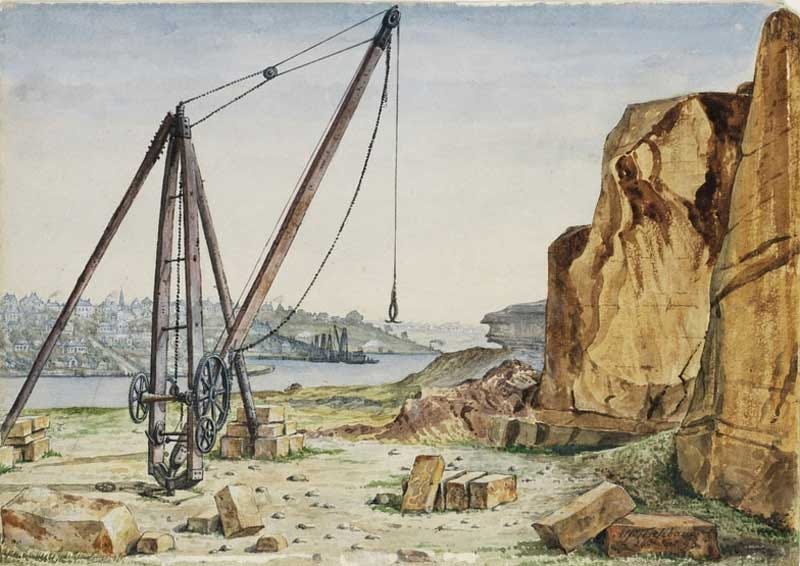
This brief historical preface intends to demonstrate a relationship born out of circumstance. In the 19th century, land grants, free trade, and population growth increased the demand for urban development. The three most productive quarries in Sydney Cove were labeled ‘Paradise’ ‘Purgatory’ and ‘Hellhole’. In retrospect, the ecological impact of this site was devastating, causing pollution, destroying habitats, and altering the landform. Yet the reliance upon this resource persisted, and by 1928, it has been reported that more masons were operating in Sydney than in the entirety of Europe.
In the 1920s, Chicago architects Walter Burley Griffin and Marion Mahoney Griffin reconsidered Sydney Sandstone’s potential beyond imitation or revival. Their various projects utilized the material as an expression of its native environment. They proposed an urbanity in which there were “no fences, no boundaries, no red roofs to spoil the Australian landscape”. At the same time, local sandstone quarries were becoming depleted, and the stone now testified to a pre-federation Anglo-philia. By the 1950s, plans were even suggested to demolish the Queen Victoria Building in favor of a car park. This multi-decade lull in sandstone architecture paved the way for a new cosmopolitanism. What I propose here is the installment of a ‘Darling Harbour vibe’, which reigned until the end of the century. Exemplified by skyscrapers, Sega World, and the Monorail, this direction was accelerated by the arrival of Sydney 2000. Here, tinted glass panes reflected a city refusing to play itself. A globalized hub, a deliberate abstraction, camouflaged as the generic backdrop of films like the Matrix.
Something began to shift halfway through the 2010s. This had been anticipated already of course, whether in the Knitlock spires of Castlecrag, or the hewn channels of Yurong Water Garden. Yet the sudden wave of redevelopment required a new vocabulary.


I think I began to notice this last year during Rīvus, the 23rd Sydney Biennale. One of its venues was The Cutaway, a grand underground cavern beneath Barangaroo Reserve, carved into the sandstone headland. The Cutaway is by no means a spectacle of urban planning - its aims to facilitate an Indigenous cultural center were scrapped in 2021. However, its regeneration seemed to define this ‘turn’, an architecture seeking to monumentalize its own environment, lurking beneath the barren earth. A Sydney which romanticizes itself, refusing to reflect its present in the sun-glinted panes of progress. The entire project of Barangaroo is underscored by artifice - evidenced by the reconstruction of a hypothetical pre-1836 shoreline. Yet the plan at least strives toward a relationship with its context. Contra Darling Habour; 42,000 tonnes of rough stone and 30,000 tonnes of crushed stone were used in construction, along with 84 species of native flora, mainly sampled from wild sites.
.
Exiting the platform at Sydney’s Central Station last night, I find myself elsewhere. A sleek white oversail cascades into tessellated sandstone. Underlit escalators serenade my arrival, segueing into the more familiar setting of Grand Concourse. This renovation belongs to a larger $11 billion dollar project across 24 surrounding hectares, which aims to ‘heal’ the suburb by 2026. The latest phase of the project is headed by Woods-Baggot, who claim it “inspires a crafted subterranean architecture seeking to capture the essence of the station, Sydney, and the unique qualities of Hawkesbury sandstone used extensively in this historic precinct.” As in The Cutaway, this is an architecture tending towards excavation rather than construction. Sandstone Futurism requires inversion; a potentiality unburied from geological time.


Nearby, there are also plans to transform the Powerhouse Museum based on “the memory of a local sandstone escarpment” - as stated by Director, first nations Emily Mcdaniel. This ‘memory’ is to be recollected in angulating brickwork, seeking “country-centered design”. Again, Sandstone Futurism manifests as an enfolding of the past within the present.
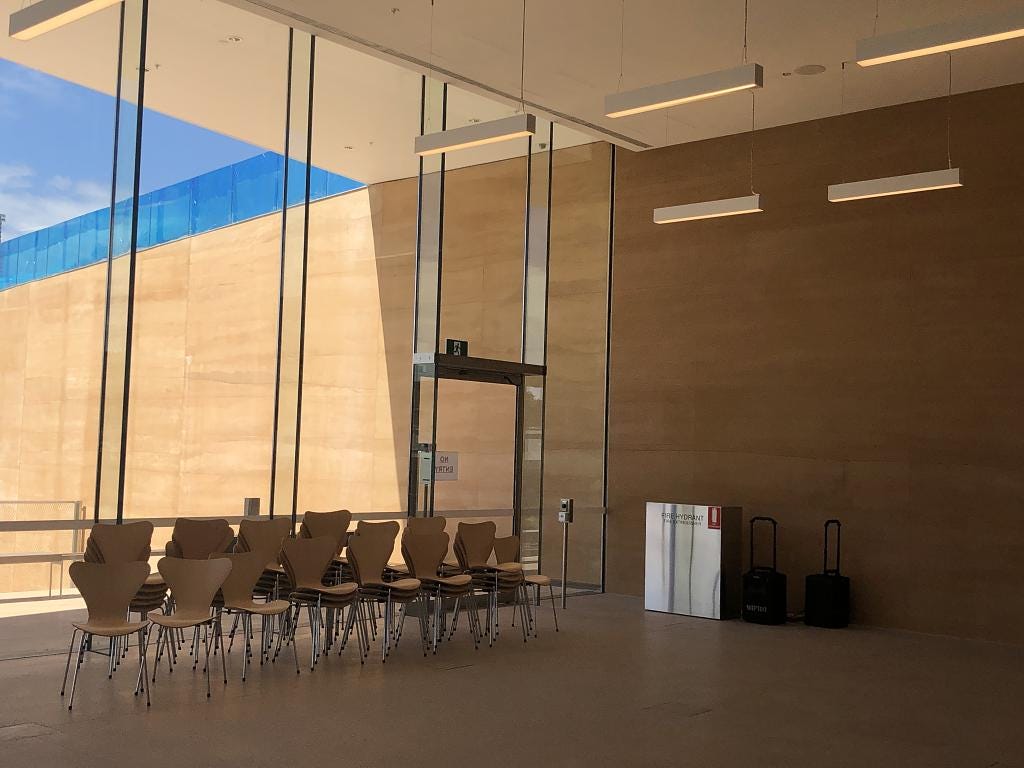
When the Powerhouse Museum’s renovation was announced in December 2022, it was overshadowed by the opening of the Sydney Modern Project, an entirely new building at AGNSW. Here, stepped pavilions descend the landscape at offset angles, as if to obey its contours. Seen from above, each boxy rooftop contains its own terrace garden, tiered like tidal pools as they undulate eastward. The entire project here is exemplified by a 250m rammed-earth wall, sampling regional types of sandstone from across NSW. John Jeffrey, senior associate at Architectus has said “this building could only be in Sydney” and he’s right. At both Sydney Modern and the Powerhouse Museum, we see a layering of historical, geological, and cultural topologies.
.
Halfway through writing this, I forgot why I had begun. I think this was meant to be a meta-analysis of cities, and how the sci-fi scapes we imagine have started tending towards regionalization. Against the Googie-washed tommorowlands of yesterday, difference has arrived. I attempted to resist historicizing this Sydney-centric contemporaneity, yet I couldn’t. I’m not intending to dissect the socio-political implications of these development plans within post-Colonial discourse. I am vibe-reporting, spit-balling, speaking out of turn. This matters so intensely because it doesn’t at all. Sydney’s relevance is predicated upon lack. Even as notions of ‘scene’ become re-territorialized, Sydney evidently fails to qualify. Yet the city still seeks to play itself.
I yearn for a universalism expressed in the particular - futurity localized around multiple vortices. Boundless sovereignty hailed in solar-paneled yurts, pagodas scaled by hydroponic farms, heat-pumped byre-dwellings. Until now, it had been uncertain how this relationship between necessity and place might be articulated in Sydney. But something is changing.